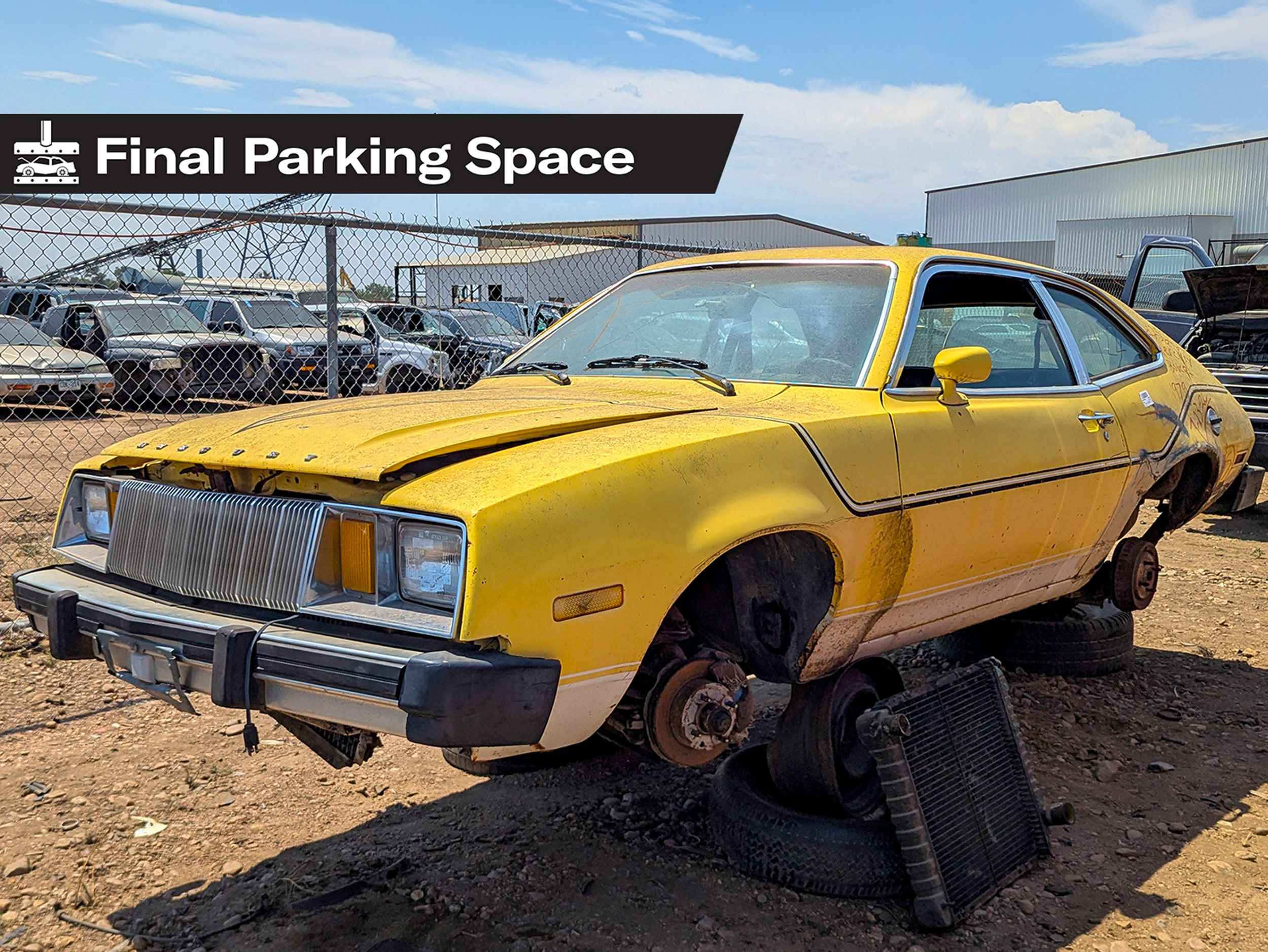
FINAL PARKING SPACE: 1979 MERCURY BOBCAT 3-DOOR RUNABOUT
Last spring, we saw a 1978 Ford Pinto 3-door Runabout in its final parking space, and today we’re returning to Ford subcompact history with that car’s Mercurized sibling: the Bobcat. This car now resides in a boneyard in Greeley, Colorado, which I was visiting on a mission to buy a decklid for my 1941 Plymouth.
The Mercury brand was created by Edsel Ford as a middle-priced marque to compete with the likes of Chrysler’s Dodge and GM’s Oldsmobile. The first model to reach showrooms was the 1939 Mercury 8. Unlike most Mercurys of later decades, this car shared no body panels with same-year Ford cars, though its styling was similar and it used Ford’s powertrain components and general chassis design.
Mercury products were supposed to be more prestigious than their corresponding Ford-badged vehicles, in theory because they were supposed to bask in the snob-appeal rays cast by Lincoln, but the brand’s image could be confusing to car shoppers as the decades went by and higher trim levels of Ford cars encroached into Mercury price territory. By the late 1960s, twinned Ford and Mercury sporty cars were cannibalizing sales from each other’s dealers.
The first compact car sold by the Lincoln-Mercury Division was the Comet, which was a snazzed-up Ford Falcon (and didn’t have Mercury badges for 1960 and 1961, because initial plans had been for it to be sold as an Edsel model).
When Ford developed its first U.S.-market subcompact, the Pinto, Lincoln-Mercury was kept out of the party for a while.
But once the OPEC oil embargo hit in the fall of 1973, Lincoln-Mercury dealers needed a more fuel-efficient car than their Maverick-twin Comet. The new Bobcat went on sale in Canada as a 1974 model, then arrived in U.S. dealerships for 1975.
The Bobcat was mechanically identical to the Pinto and looked the same as its penny-pinching Dearborn sibling except for two important differences: the Bobcat got a domed hood that allowed it to have a taller, chromier grille than the Pinto, and its taillights were bigger.
For the little Mercury’s first year in the USA, 34,234 were sold. For 1976, the Mercurized Pinto outsold the Mercurized Maverick. Love that Bobcat!
Pinto/Bobcat sales were already declining when Mother Jones magazine came out with its “Pinto Madness” article in late 1977, and the controversy sped up the process. If you want more details, read the ’78 Pinto Final Parking Space episode.
Now we’ll look at today’s FPS subject. It was built at Metuchen Assembly in New Jersey and sold through the Denver sales office. Bobcats were also built in California and Ontario.
The 1979 Bobcat’s base engine was the 2.3-liter SOHC four-cylinder, but this car has the optional 2.8-liter OHV Cologne V-6.
This engine was rated at 102 horsepower and 138 pound-feet, and it added $273 to the car’s $3988 list price (those figures would be $1335 and $19,497, respectively, in 2026 dollars). This engine was available in the Pinto, too, but the only junkyard example of a V-6 Pinto I’ve ever found was a 1977 Cruising Wagon in Los Angeles.
Those power numbers don’t sound like much today, but the base 2.3 was rated at just 88 horses and 118 pound-feet. In a car weighing in at about 2500 pounds (a bit more than a 2026 Miata), the Cologne-powered Bobcat offered decent performance by Middle Malaise Era standards.
Getting the Cologne engine in the ’79 Bobcat mandated the $307 ($1501 today) purchase of a three-speed automatic transmission instead of the base four-speed manual, presumably because it would have cost too much to make the rest of the drivetrain survive the punishment of manual shifting.
This car has the optional Sports Accent Group with Sports Instrumentation, which added $341 to the price ($1667 after inflation).
Air conditioning was available for $484 ($2366 now), but this car didn’t get it.
The seats are the optional low-back buckets in “chamois vinyl,” which were part of the $182 Deluxe Interior option package (that’s $890 in present-day dollars). As you can see, this car ended up costing close to 30 grand in 2026 dollars, about what you’d pay for a 2026 base Accord or Camry.
Like the Pinto and every other new car or light truck sold in the United States as a 1979 model (except for the Volkswagen Type 1 Beetle, then in its last year of U.S.-market sales and available only as a convertible), this car has front disc brakes. The final year for four-wheel drum brakes on the Pinto/Bobcat was 1974, although power front discs didn’t become standard Pinto/Bobcat equipment until 1979.
The paint is Bright Yellow, and I feel fairly certain that the stripes are dealer-applied or aftermarket.
The stripes are sufficiently weathered that we can assume they were applied soon after purchase.
The Pinto lasted through the 1980 model year, after which it was replaced by the new front-wheel-drive Escort.
Lincoln-Mercury dealers weren’t left out of the subcompact party after 1980; they got a Mercurized Escort called the Lynx.
The talking taxidermied bobcats in these commercials haven’t aged well.
Find big values at the sign of the little cat (meow).
By the end, Bobcat TV commercials tended to be part of price-emphasizing Monarch or Zephyr promotions.
The post Final Parking Space: 1979 Mercury Bobcat 3-Door Runabout appeared first on Hagerty Media.
Looking to purchase a car? Find your match on the MSN Autos Marketplace 2026-09-08T13:09:24Z